
Good to Know

Arrival City
Kathmandu

Depature City
Kathmandu

Accommodation
Tea House & Hotel

Meals
Included

Trip Grade
Difficult

Maximum Altitude
5,350m/17,552ft

Activity
Trekking
Highlights
- Cross both Kang La Pass at 5,350m and Jeng La Pass at 5,220m, two of the most demanding high passes in Nepal
- Visit Shey Gompa, an ancient monastery built in 1655 and home to the mysterious Crystal Mountain
- One of the most complete forms of upper dolpo trek available, crossing genuinely remote trans-Himalayan terrain
- Explore the pristine waters of Phoksundo Lake, the deepest lake in Nepal
- Observe the rare practice of Bonpo religion, still preserved in villages throughout the region
- Walk through Ringmo village and remote hamlets like Saldang, Namgung, and Dho Tarap
- Take in views of the Dhaulagiri Himalayan Range alongside countless other peaks
- Cross vibrant hamlets like Tarakot and Khanigaon on your way back toward Juphal
- A genuine off the beaten track experience, often described as a living museum of Himalayan culture
Overviews
Upper Dolpo Trek, 25 Days
If you have already trekked in Nepal a few times, chances are you have noticed how crowded routes like Everest Base Camp or Annapurna Circuit can get, especially during peak season. If you are searching for something that feels genuinely remote, culturally untouched, and far removed from the busier trekking trails, that search usually leads to one place.
The upper dolpo trek leads you to one of the most remote areas of Nepal, which, due to its unique culture, has frequently been referred to as a living museum of Himalayan culture. Unlike teahouse to teahouse treks, many parts of this trek are pure wilderness camping, crossing high mountain passes, and encountering villages that practice Bonpo religion, an ancient belief system dating back before Tibetan Buddhism.
This 25 day upper dolpo trekking itinerary is not for beginners. It demands real stamina, comfort with basic camping conditions in places, and the ability to handle two major passes, Kang La and Jeng La, both above 5,200m. In exchange, you get Shey Gompa and its famous Crystal Mountain, the pristine waters of Phoksundo Lake, and a level of cultural and geographic isolation that busier routes simply cannot offer.
Whether you have already completed demanding treks elsewhere in Nepal and want a genuine step up in remoteness, or you are specifically searching for an upper dolpo circuit trek that avoids crowds entirely, this itinerary delivers one of the most authentic and challenging trekking experiences available anywhere in the Himalayas.
History and Culture
Upper Dolpo has close cultural and geographic ties to Tibet, and there is good reason for that too. The place has stayed isolated for centuries now, ensuring that their dialect, lifestyle, and culture have survived without any significant changes. The region, which we explore during our trekking route in upper dolpo, has been called a living museum of the world because of this rich culture.
One of the oldest monasteries in the region is Shey Gompa, which was built in 1655 and even today is devoted to the worship of Sakyamuni Buddha. The monastery also has some amazing ancient artwork and artifacts dating back several centuries. The whole region, however, is one of the last refuges of Bonpo religion, which is a much older religion than Buddhism itself in Tibet.
Landscape
The journey starts with a flight from Kathmandu to the Terai district town of Nepalgunj, followed by another flight into the mountain airstrip of Juphal, and these flights take you through quite different scenery compared to the scenery of the Himalayas yet to come. The trail then continues through vegetable farms, forests, and a trans-Himalayan eco-system, which transforms from green to barren land as one advances on to higher altitude regions.
The Ringmo village along with the nearby Phoksundo Lake is one of the most scenic locations on this entire trek, where the pristine water is set against the backdrop of the Himalayan mountain range. Later in the trek, as it moves ahead to Kang La Pass, there is the sight of the Dhaulagiri Himalayan range along with many other snowcapped mountains.
Best Season for This Trek
Spring, from March to May, and autumn, from September to November, are the best months for this upper dolpo trekking route, offering the clearest skies and most stable conditions for crossing both Kang La and Jeng La Pass. Fall in particular is popular since it follows the monsoon, leaving the air dry and the lower valleys green from the rains.
During winter, the weather becomes extremely cold with the temperature dropping down to even minus 20 degrees centigrade at some places but the sun remains shining bright while the trails become much quieter. During the monsoon season in June and August, many of the trails get washed away and become quite difficult to pass through.
Weather and Temperature
There is quite a difference in temperature in the vast range of altitudes covered in this trek. The villages near Juphal and Suligad Ghat remain comparatively warm, but the conditions become very cold in places such as Shey Gompa, Jeng La Phedi, and especially the two passes.
Because this trek reaches 5,350m at Kang La Pass, nights at the higher camps regularly drop well below freezing, even during the warmer trekking seasons.
Food, Water, Wifi and Accommodation
Accommodation shifts throughout this trek. City stays in Kathmandu and Nepalgunj use standard hotels, while the trekking portion relies mostly on basic teahouses, with some sections requiring proper camping gear, tents, and kitchen equipment carried in by your crew.
The meals are freshly made on the entire journey and consist of well-known meals such as dal bhat, noodle soup, as well as easy to make breakfast food, while fresh fruits will be provided daily in the evening after dinner. The drinking water cannot be sourced from the tap water, therefore a bottle together with some water purifiers is crucial.
Wifi is simply not available once you move beyond Juphal and into the more remote sections of the trek, a genuine disconnect that some trekkers specifically seek out on a trip like this.
Permits
You will need a Shey Phoksundo National Park permit, a Restricted Area Permit specific to Upper Dolpo, and a TIMS card for this trek. All three are standard requirements for this restricted region and are arranged by your trekking agency ahead of time, keeping the process simple on your end.
Outline Itinerary
Day 1
Your Upper Dolpo Trek begins with your arrival at Tribhuvan International Airport, where a representative will meet you and transfer you to your hotel. Later that day, you will meet the office staff and the guides who will accompany you for the duration of the trek, covering what to expect over the coming three and a half weeks. Overnight at a 3-star hotel in Kathmandu.
Day 2
In the morning, you will explore the famous Swayambhunath stupa, which is revered by both Hindus and Buddhists and provides you with some magnificent views of the valley. Next, you will make your way to the important Hindu temple, Pashupatinath, and then to Kathmandu Durbar Square. You will end the day with views of the sunset from the Boudhanath. Over-night stay in a 3-star hotel in Kathmandu.
Day 3
An early flight takes you west to the Terai town of Nepalgunj, a journey offering a genuinely diverse set of landscapes from the air. Once you land, you will have time to explore the local market and surrounding areas, getting a first taste of the region’s distinct culture before heading deeper into the mountains. Overnight at a tourist standard hotel in Nepalgunj.
Day 4
With an early morning flight, you will reach the hilly town of Juphal, where there are impressive sights of the Annapurna and Dhaulagiri Himalaya ranges from the sky. After a brief stopover, you will commence trekking amid vegetable farms to the banks of the Thuli Bheri river, further trekking along Suli Khola in the company of Dhaulagiri Himalaya range. Accommodation for the night will be at a simple tea house at Suligad Ghat.
Day 5
The trail continues through lush green forest in genuine solitude, opening gradually into wider valley terrain. You will experience the trans-Himalayan ecosystem that governs this entire region firsthand, with the trail alternating between ascents and descents through thinning forest before reaching Renje village. Overnight at a basic teahouse in Renje.
Day 6
On this day, you get a chance to experience proximity to the deepest lake in Nepal. The hike out of Renje repeats itself again with its ascents and descents through the forest and with views of the majestic Himalayas opening up on the other side of the hills that disappear behind you as you approach Ringmo village. After Ringmo, you will go on to Phoksundo Lake. Overnight stay in a teahouse in Phoksundo.
Day 7
An early start rewards you with one of the most stunning views of the entire trek, the golden Himalayas reflected in the sparkling waters of Phoksundo Lake at sunrise. You will also have time to explore Ringmo village, offering a perfect opportunity to get acquainted with local Dolpo culture. Overnight at Ringmo Village.
Day 8
The trail heads through a steep Himalayan section, leaving behind the comfort of lush forest and hilly landscapes as you approach the top western frontier of Phoksundo Lake. In places, the trail is supported by logs of wood tied together, a genuine reminder of just how remote this journey has become. Overnight camping near Phoksundo Khola.
Day 9
The trip moves on in a northward direction along a trail that is parallel to the valley of glaciers. This takes you to a wooden bridge, where you can see the confluence of Phoksundo Khola and other mountain streams. You will get to witness Chamlang Peak which is 6,739m high and Peak 7 at 6,105m. After which, you will climb up the hills and set up your camp near Kang La Pass.
Day 10
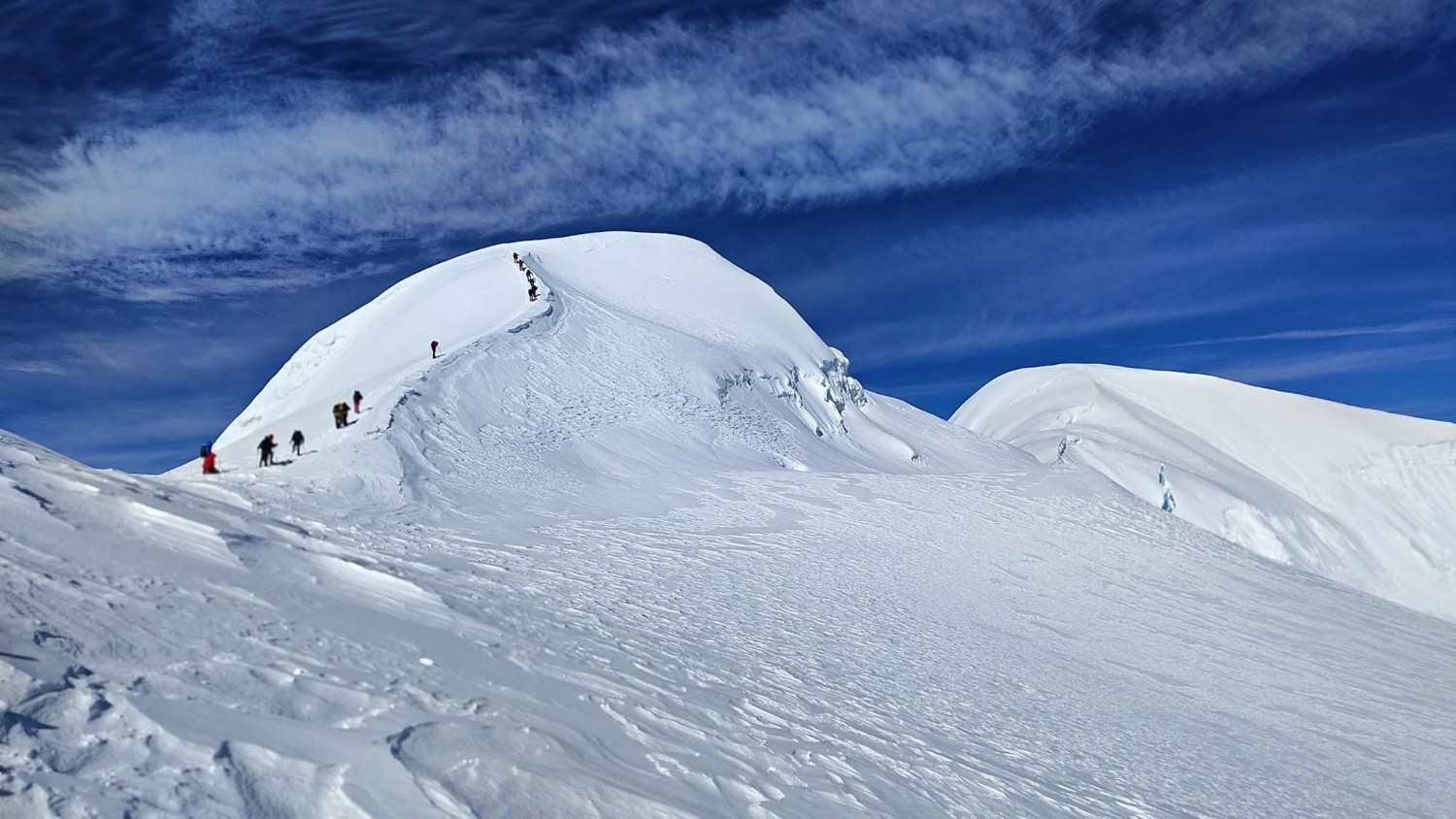
Today marks the highest point of the entire trek. Carefully picking your way through a snowy Himalayan trail, you reach the summit of Kang La Pass, rewarded with stunning views of the Dhaulagiri Himalayan Range bordering the mountains toward Tibet. Descending via the mountain pass and crossing the opening valley several times, you reach Shey Gompa. Overnight at a basic teahouse in Shey Gompa.
Day 11
This is your second rest day, dedicated to exploring one of the oldest monasteries in the region, built in 1655 and dedicated to Sakyamuni Buddha. The monastery holds ancient art and artifacts, some dating back thousands of years, and the region is known for its practice of Bonpo religion. Nearby, Crystal Mountain draws pilgrims who circumambulate it as part of their spiritual practice. Overnight near Shey Gompa.
Day 12
Today marks the second mountain pass of the trek. This pass is not only breathtakingly beautiful but also physically exhausting, offering incredible views of the valley that opens up below the pass upon completing your hike. Passing through a descent into yak pastures, we make our way to Namgung village and the Namgung monastery, popularly known as the red stone monastery. Stay for the night at the teahouse in Namgung.
Day 13
Nearly at the midpoint of the journey, today’s trail heads down through diverse, barren mountain landscapes on a strenuous descent that ends with views of Saldang hamlet perched high above the Nagma Khola stream. Overnight at a basic teahouse in Saldang.
Day 14
Following the same northern route, you will have an easy journey to Yangze Gompa as there are no major elevation gains in this section of the route. The path passes through Marang and Ki villages to finally arrive at the tributary of the Panzang River from where the path goes to the gompa. Stay at the teahouse nearby.
Day 15
Heading back through Saldang village, the trail descends through terraced fields accompanied by chortens and seas of prayer flags. Passing Chaiba Monastery and a short stop at Namde Monastery along the riverbank, you follow the sandy banks all the way to Sibu. Overnight at a basic teahouse in Sibu.
Day 16
A relatively pleasant day, the trail continues along the banks of the Nam Khong River heading east, often alongside caravans traveling toward Tibet for trade. After reaching the convergence point of two Himalayan streams, the trail climbs steeply toward pasture land where you set up camp for the night. Overnight camping at Jeng La Phedi.
Day 17
The final of the three mountain passes, Jeng La, requires careful navigation through an icy, snow covered trail. You will take in views of the north face of the Dhaulagiri massif at 8,167m before reaching the summit, beyond which the Tarap valley gradually opens up. A rocky descent brings you to Dho Tarap. Overnight at a basic teahouse in Dho Tarap.
Day 18
Your final scheduled rest day is spent exploring this enchanting valley, surrounded by irregular stone walls and home to small settlements of Magar and Dolpo people. Nearby, you can visit both a Buddhist monastery and a Bonpo monastery on the outskirts of the hamlet. Overnight at Dho Tarap.
Day 19
The journey gradually descends toward Tarap Khola through a narrow valley trail. The alpine vegetation gives way once again to lush green forest as the trail descends through the tree line, reaching the convergence point of Tarap Chu and Lang Khola before following the sandy riverbanks to Karma Kharka. Overnight camping at Karma Kharka.
Day 20
Continuing the descent out of the Dolpo region, the trail follows the gorge of the Tarap River, with sections offering no clearly visible path, a genuine reminder of how remote this route remains even on the way out. You will take in views of the Himalayan rural landscape before reaching Khanigaon beside the Tarap River. Overnight camping at Khanigaon.
Day 21
Early start leads you to the descent to Tarakot and then to Dunai along the way to Lalberi followed by a riverside trail. There is also a monastery known as Sandul Gompa on the way and then the trek leads you further along the Bheri River to Dunai. Night halt at a simple tea house in Dunai.
Day 22
The final trekking day begins with a lovely Himalayan breakfast before you make your way down to Juphal alongside the Bheri River, passing through several vibrant hamlets including Dhupi Chaur, Rupagad, Kalagauda, and Motipur along the way. Overnight at a basic teahouse in Juphal.
Day 23
This day is built in specifically as a buffer in case your flight out of Juphal gets delayed, which can happen due to mountain weather conditions. If your flight departs on schedule the following morning as planned, you can use this day to rest or explore the local area at your own pace. Overnight at a basic teahouse in Juphal.
Day 24
An early morning flight takes you out of Juphal to Nepalgunj, followed by a brief rest before a second flight brings you back to Kathmandu. Once you arrive, you will head directly to your hotel for refreshments, with time permitting to explore local markets for souvenirs. Overnight at a 3-star hotel in Kathmandu.
Day 25
Your Upper Dolpo Trek comes to a close today. A representative will transfer you to Tribhuvan International Airport in time for your flight home, bringing an end to a genuinely remote and unforgettable three and a half week journey through one of the most isolated regions in the
The Trip Cost Includes
- Experienced, licensed, English speaking trekking guide
- Porter and full insurance for guide and porter
- 3-star hotel accommodation in Kathmandu with breakfast, and tourist standard hotel in Nepalgunj
- Teahouse and camping accommodation during the trek
- All meals during the trek, including fresh seasonal fruit after dinner
- Airport pickup and drop by private vehicle
- Kathmandu to Nepalgunj to Juphal to Nepalgunj to Kathmandu flight tickets
- Shey Phoksundo National Park permit, Restricted Area Permit, and TIMS card
- Full day guided city tour in Kathmandu with private vehicle
- Down jackets and sleeping bags provided upon request
- First aid medical kit
- Good quality tents and kitchen utensils for camping sections
- Duffel bag, t-shirt, and trekking map
- 1 hour trekker’s massage or yoga session after trip completion
- Local SIM card
- Welcome and farewell dinner at a traditional Nepalese restaurant with ethnic music and dance
Note: exact upper dolpo trek cost figures for this itinerary are still being finalized and will be shared separately based on group size, since this section focuses on what is covered rather than pricing.
The Trip Cost Excludes
- Extra night accommodation in Kathmandu due to early arrival, late departure, or early return from the mountain
- Cost for additional side trips
- Extra porter charges beyond the standard allocation
- International airfare to and from Kathmandu
- Meals in the city except for breakfast and the mentioned special dinners
- Nepal entry visa fee
- Personal expenses like phone calls, laundry, bar bills, battery recharge, extra porters, bottled or boiled water, and showers
- Tips for guide and porter
- Travel insurance covering emergency rescue and evacuation
Add-ons and Options
Shape this upper dolpo circuit trek around your own comfort level with a few simple add-ons.
- Extra Buffer Days: Add additional contingency days given the remote flight dependent nature of this route
- Luxury Hotel Upgrade: Upgrade your Kathmandu and Nepalgunj accommodation to a higher category
- Private Room Upgrade: Enjoy more privacy where teahouse accommodation allows
- Extended Rest Days: Add extra acclimatization time at Phoksundo Lake or Dho Tarap
How to Customize Your Trip
Step 1: Choose your preferred departure date within the recommended season
Step 2: Enter the number of travelers
Step 3: Select your preferred add-ons
Step 4: Confirm accommodation and meal preferences
Step 5: Complete your booking
Trek Gallery
Trek Essentials
- Sun Hat
- Warm Beanie
- Sunglasses With UV Protection
- Base Layer
- Fleece Jacket
- Down Jacket
- Windproof Outer Shell
- Lightweight Gloves
- Warm Insulated Gloves
- Trekking Pants
- Thermal Leggings
- Waterproof Shell Pants
- Trekking Boots
- Wool Socks
- Camp Shoes
- Ice Cleats Or Micro Spikes
- Sunscreen
- Lip Balm
- Wet Wipes
- Hand Sanitizer
- Daypack
- Duffel Bag
- Trekking Poles
- Headlamp
- Power Bank
- Water Bottle With Purification Tablets